

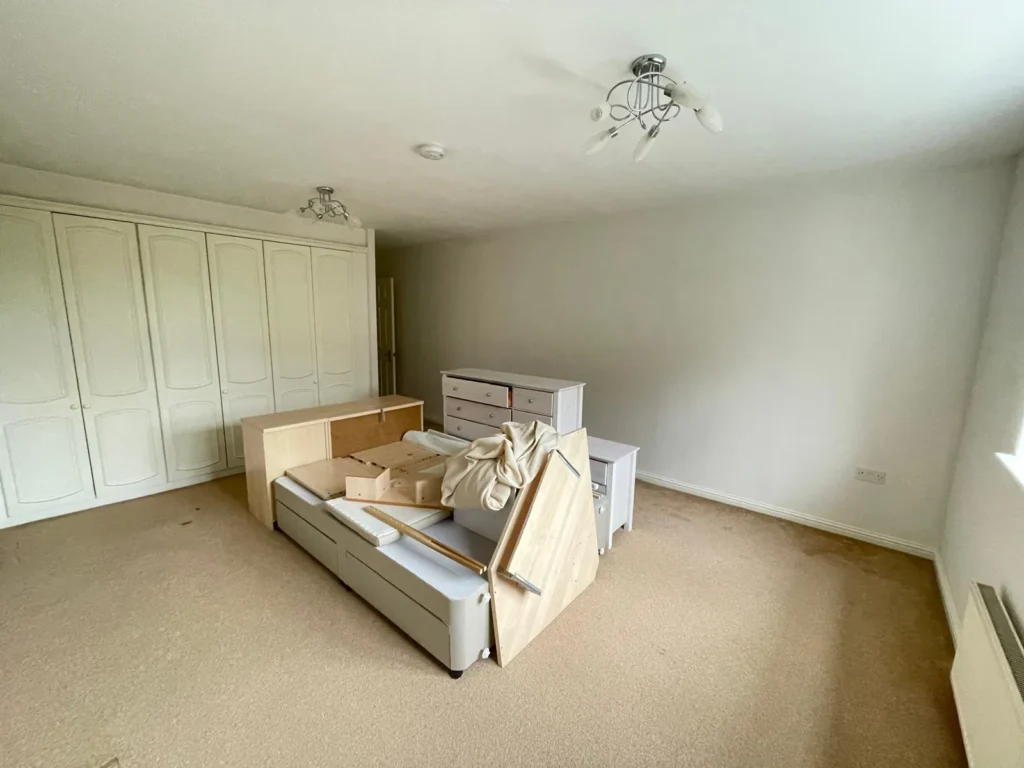
The order to paint a room decides how much of the job you end up doing twice. Get it wrong and ceiling spatter lands on finished walls, sanding dust settles in wet gloss and tape lifts fresh paint.
Below is the sequence our interior painting team follows in Manchester homes: preparation first, then ceiling, walls and woodwork. Each step sits where it does for a reason.
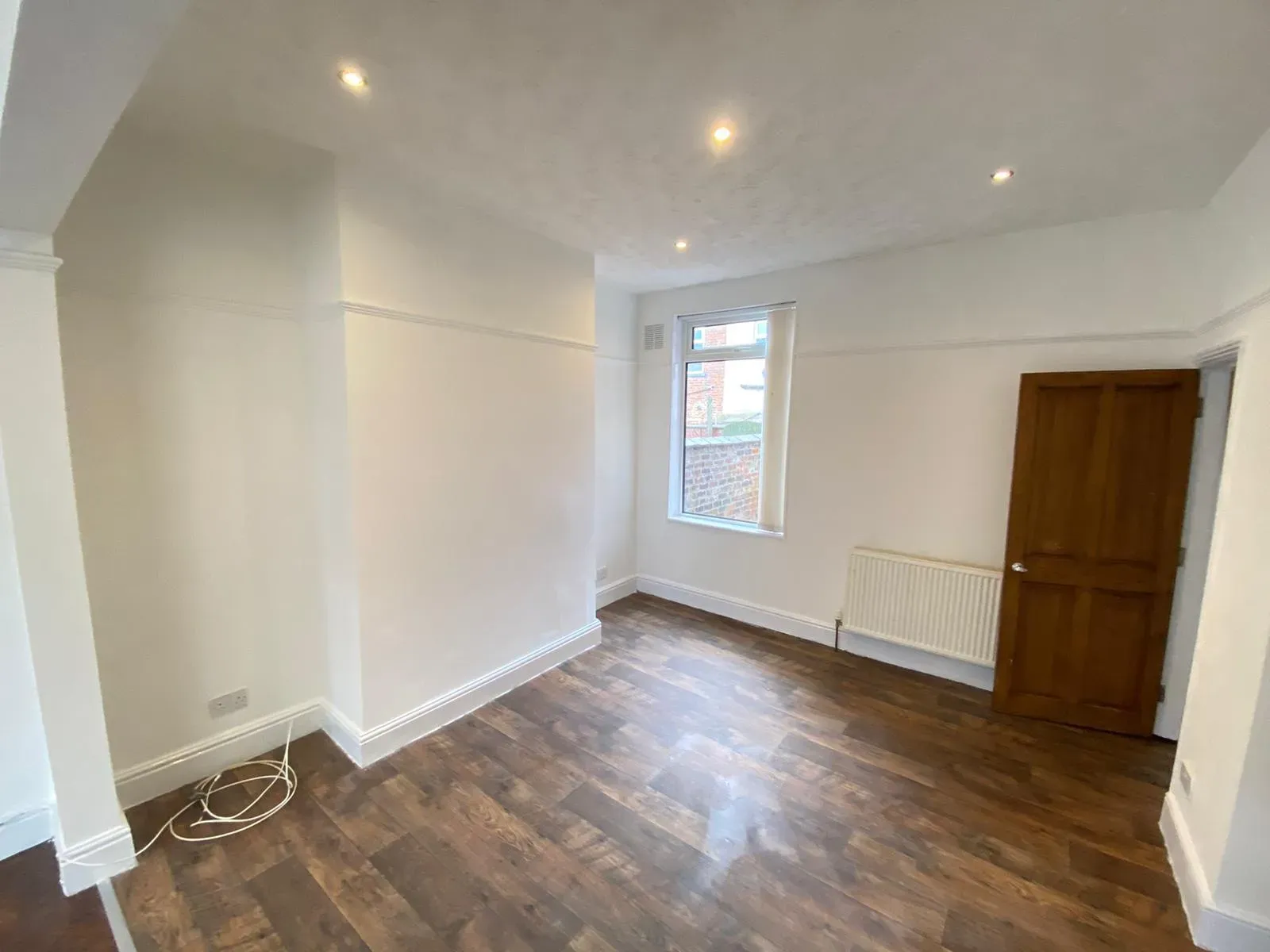
In short
- Do all the preparation first: clear, protect, fill, sand, caulk and dust down.
- The standard order is ceiling, walls, then woodwork, with skirting boards last.
- Working top to bottom means drips and dust only fall on surfaces that are not finished yet.
- Painting woodwork first is a legitimate alternative, common on new builds and where trim is sprayed.
- Cut in and roll one wall at a time, so brushed edges are still wet when rolled.
- Bare new plaster adds a mist coat at the very start, and filling moves to after it.
Before any paint: clear, protect and prepare
Every professional sequence starts the same way. The messy work is finished before a tin is opened, because filling and sanding create dust. Wet paint does not forgive dust.
The room is cleared, or the furniture is grouped in the centre and covered with polythene. Cotton twill dust sheets go on the floor, as they absorb drips and do not slide underfoot. Curtains, poles, pictures and hooks come down, and sockets and switch plates are masked.
The preparation sequence
- Walls and woodwork are washed with sugar soap, especially in kitchens and hallways, then rinsed.
- Cracks are raked out and filled, with deep holes built up in layers. The filler is sanded flush once it has hardened.
- Old gloss on skirting, doors and frames is keyed with an abrasive pad, so the new coat has something to grip.
- Decorator’s caulk is run into gaps along skirting, architraves and the ceiling line, and left to dry.
- Water marks and nicotine stains are sealed with a stain blocker such as Zinsser Cover Stain or B-I-N.
- Filler and bare patches are spot-primed, then skirting tops, sills and floor edges are vacuumed and the woodwork is wiped down.
This is where the finish is won or lost. It is also the stage rushed jobs skip, which is why we treat surface preparation and finishing as a service in its own right.
The right order to paint a room: ceiling, walls, woodwork
Once the room is prepared, the standard order to paint a room is top to bottom. Gravity decides most of it. Rollers throw a fine mist and brushes drip, so each stage should only mark surfaces still waiting to be painted.
Why the ceiling goes first
Rolling a ceiling puts spatter on everything underneath, so nothing below it should be finished yet. The edges are cut in first, including around the light fitting. The ceiling is then rolled in lanes, laying off towards the main window so faint roller marks do not catch the light.
The ceiling paint is taken a few millimetres onto the top of the walls. The wall colour is cut in to that line later, which is far easier than cutting white onto a finished coloured wall. In a 1930s semi with a picture rail, the ceiling colour often runs down to the rail.
Textured ceilings go first too. However, older Artex should not be sanded or scraped until it has been tested, because some older textured coatings contain asbestos.
Why the walls come second
With the ceiling finished, the walls are cut in along the ceiling line, into the corners and around the woodwork. The wall paint is allowed to run slightly onto the edges of the skirting, frames and architraves. That overlap is deliberate, because the woodwork paint will cover it.
The reverse is much harder. Gloss or satin that strays onto a wall leaves a shiny band that matt emulsion struggles to hide. Two coats are normal on walls, although a strong colour change can call for a basecoat or a third coat.
Why the woodwork comes last
Woodwork carries the most visible finish in the room, and the least forgiving one. It therefore goes on when nobody needs to lean a ladder against it or drag a dust sheet past it. The sequence runs top to bottom again:
- Windows first, early in the day, so the sashes or casements can be closed by evening.
- Picture rails and dado rails next.
- Door frames and architraves, then the doors themselves.
- Skirting boards last, after one more vacuum, because dust settles on them all day.
A common trade refinement is to apply the woodwork undercoat early, while the ceiling coats dry. The final satin or gloss still goes on last. For the detail, including a carpet-safe method, see our guide to painting skirting boards.
Painting woodwork before walls: the debated alternative
Some decorators do the woodwork before the walls. It is a legitimate method, not a mistake, and it has clear uses:
- Sprayed trim. Overspray drifts onto the walls, and the wall coats that follow cover it.
- New builds. The walls are bare and need several coats anyway, so finishing the woodwork first loses nothing.
- Oil-based gloss. It is slow to dry and harden, so it can cure while the walls are being done.
The catch is the cut-in. The wall paint has to meet finished woodwork in a crisp line, either freehand or with tape. Tape on paint that has not fully cured can pull it straight off. As a result, woodwork-first rewards a very steady hand and punishes a hurried one.
In a lived-in home being repainted, ceiling, walls, then woodwork is usually the safer order. Woodwork-first earns its place when the walls are bare or the trim is being sprayed.
Cutting in before rolling
Within each surface, the order matters too. The edges are cut in with a brush first, then the open area is rolled. The timing is the key: the roller should meet the brushed band while it is still wet.
Cut in a whole room and then roll it, and the edges will have dried. The result is picture framing, a visible border of different sheen and texture around every wall. It shows most in dark colours and in low winter light.
So work one wall at a time. Cut in, roll straight away in overlapping passes, then lay off in light strokes from top to bottom. Keep a wet edge and never go back over paint that has started to tack. On a warm day, or with a fast-drying trade paint, cut in smaller sections still.
Drying and recoat times between coats
Drying time is the part of the sequence people most often ignore. A surface can be touch dry in an hour and still be too soft to recoat. Follow the manufacturer’s recoat time on the tin, which for water-based paints is typically a few hours.
| Surface | Place in the order | Typical finish | Usual recoat time (check the tin) | What goes wrong out of order |
|---|---|---|---|---|
| Bare new plaster | Before everything | Mist coat | A few hours, once dry | Top coats flash, peel or show every flaw |
| Ceiling | First | Matt emulsion | Typically 2–4 hours | Roller spatter marks finished walls |
| Walls | Second | Matt or durable matt emulsion | Typically 2–4 hours | White has to be cut onto coloured walls at the ceiling line |
| Woodwork, water-based | Last | Satin or eggshell | Often 4–6 hours | Wall paint splashes onto finished trim |
| Woodwork, oil-based | Last, or first if it needs curing time | Gloss over undercoat | Usually around 16 hours, or overnight | Dust and spatter set into slow-drying gloss |
These times assume a reasonably warm, ventilated room. In a cold back bedroom in November, everything slows down. Therefore keep the heating on low and a window slightly open, rather than blasting heat at wet paint.
Touch dry is not the same as cured, either. Water-based finishes stay soft for days, so furniture and pictures should go back gently.
Painting room by room in an occupied house
Most homes stay lived in while they are decorated. The answer is to keep the same order inside every room and plan which room goes when.
- Start with the rooms you need least, such as a spare bedroom or dining room.
- Schedule the kitchen for when the household can manage around it for a day or two.
- Leave the hall, stairs and landing until last, because every ladder, dust sheet and piece of furniture passes through them.
This is how we work in occupied family homes in Sale, one room at a time. For a realistic idea of timings, see our guide to how long it takes to paint a house.
Empty properties are different. On end-of-tenancy turnarounds in Withington, every ceiling is done, then every wall, then all the woodwork across the house. Each room dries while the next is painted, so no time is lost waiting. Landlords and letting agents can find out more about our residential and commercial painting.
How new plaster changes the order
Fresh plaster adds a stage at the very start. It is porous, so the first coat is a mist coat: watered-down contract matt, or a new-plaster paint such as Dulux Trade Supermatt. Standard vinyl emulsion is not used, as it can sit on the surface and later peel.
The plaster must be dry first, an even pale pink with no darker patches. A thin skim in a warm house can be ready in a week or two. Thick plaster in a damp winter takes much longer. The mist coat then goes on the ceiling first, then the walls.
Importantly, the mist coat shows up every flaw. So filling, sanding and caulking happen after it, then the full coats follow. On new builds and fresh plaster across Salford, the woodwork often arrives primed and is frequently finished before the final wall coats. Our guide to painting new plaster with a mist coat covers mixing and drying in detail.
Where we draw the line
We do not paint a room in the order that looks quickest on day one. Rolling colour onto the walls first transforms a room by lunchtime, and it is tempting. However, the ceiling spatter, sanding dust and trim paint that follow all land on that finished wall.
The time saved on day one is then spent touching up on day three, and touch-ups rarely blend in. So our first day often looks slow: sheets down, filler in, woodwork keyed, caulk drying and very little colour. That is the job being done properly.
Plenty of people paint a room well themselves by following this order and respecting the drying times. A professional is worth calling in these cases.
- Tall Victorian ceilings and stairwells.
- Badly stained, cracked or flaking surfaces.
- Rooms with panelled doors and deep skirting.
- A firm deadline, such as a sale or a new tenancy.
If a wall needs replastering, we will tell you before any paint goes on, because that is a job for a plasterer.
Get a free quote in Manchester
If you would rather hand the whole sequence over, we are fully insured, 5-star rated house painters across Manchester, based in Cheadle. We will visit, look at the rooms and explain the order we would work in.
Contact us for a free, no-obligation quote, or call 07835 733353.
Frequently asked questions
Do you paint the ceiling or the walls first?
Paint the ceiling first. Rolling a ceiling throws fine spatter onto everything below, so the walls should not be finished yet. Take the ceiling paint a few millimetres onto the top of the walls, then cut the wall colour in to that line once the ceiling is dry. It is far easier than cutting white paint onto a finished coloured wall.
Should you paint skirting boards before or after the walls?
Most decorators paint skirting boards after the walls, and usually last of all. Wall paint that strays onto the skirting is simply covered by the woodwork coat, whereas gloss or satin on a wall is hard to hide. Some trades paint woodwork first, particularly on new builds or where trim is sprayed, then cut the walls in to it carefully.
Do you cut in before or after rolling?
Cut in first, then roll, but work one wall at a time. The roller should meet the brushed edge while it is still wet. If you cut in a whole room before rolling, the edges dry and show as a band of different sheen and texture, known as picture framing. It is most noticeable with darker colours and in low light.
How long should you wait between coats of paint?
Follow the recoat time on the tin rather than the touch-dry time. For most water-based emulsions that is typically two to four hours, and water-based satin often needs a little longer. Oil-based undercoat and gloss usually need around 16 hours, or overnight. Cold, damp rooms slow drying considerably, so allow extra time in winter.
Can you paint a room in one day?
A small room can sometimes be painted in a day if the walls are sound and it only needs a refresh in a similar colour. Most rooms take longer once washing, filling, sanding, caulking, two coats on the ceiling and walls, and the woodwork are included. Drying and recoat times, rather than effort, usually set the pace.
Do you need to wash walls before painting?
Yes, in most rooms. Walls in kitchens, hallways and around light switches carry grease and fingerprints that stop new paint bonding properly. Wash them with sugar soap, rinse with clean water and let them dry. Do it at the start of the job, before filling and sanding, so the room is clean before any paint is opened.
