

Office painting is rarely difficult because of the walls. It is difficult because the business has to keep running while it happens. Staff need their desks, shops need to trade and salons need to take bookings.
Our residential and commercial painting service is built around that, with evening, weekend and phased work. This guide covers how the work is planned, what paperwork to expect and which finishes stand up to daily wear.
In short
- Most office painting can be done in the evenings and at weekends, so there is rarely any need to close.
- Larger spaces are split into zones and handed back one at a time.
- Low-odour, water-based paints mean a room painted overnight can usually be used the next morning.
- Expect RAMS and insurance documents before work starts; landlords and managing agents usually ask for them.
- Corridors, kitchens and toilets need scrubbable finishes, and brand colours should be sampled and recorded.
- Every job should end with a snagging walk-round before handover.
Commercial painting without closing your doors
The aim is simple: your customers and staff should barely notice the decorators were there. In practice, that takes more planning than the painting itself. So before quoting, we want to know how the space is used, hour by hour.
The questions asked on a site visit include:
- When is the space empty, and for how long?
- Who holds the keys, fobs and alarm codes out of hours?
- Is there a managing agent, a loading bay or a goods lift to book?
- Where can materials and equipment be stored overnight?
- Are any areas off limits on certain days, such as a stockroom on delivery day?
Once those answers are in, the programme largely follows. It also shows which areas can be finished in one visit and which need splitting. We work across Manchester and Greater Manchester, whether the premises is a city-centre office or a unit on a retail park.
Out-of-hours office painting: evenings and weekends
In most cases, office painting happens while the office is empty. Evening shifts start once the last person leaves, and weekends cover the bigger areas. By the morning, furniture is back, floors are clear and the space is ready to use.
It suits small businesses too. For instance, an estate agent or an accountant’s office can have its reception repainted over a single weekend. Nobody on Monday sees a dust sheet. Homeowners ask for the same flexibility, which is why we offer evening and weekend work for commuters in Eccles.
City-centre buildings bring their own rules. Many have building managers who want notice, contractor inductions and booked lift slots. Loading bays are often time-limited. Therefore, those details are settled before the first evening, not on it.
Phased, zone-by-zone programmes
For a larger office, or a shop that trades seven days a week, the work is split into zones. Each zone is cleared, protected, painted and handed back before the next one starts. As a result, staff move desks for a night or two, not a fortnight.
A typical open-plan floor might be split like this:
- Zone one: meeting rooms and reception, done over a weekend.
- Zone two: half of the open-plan area, done over two or three evenings.
- Zone three: the other half, with desks swapped across.
- Zone four: corridors, kitchen and toilets, left until last so any knocks from moving furniture are put right at the same time.
Shop painting and retail
Retail work is usually done after closing, one section at a time. Stock is moved or covered, and displays go back before opening. Shopfronts are a separate job, since they depend on the weather and on footfall outside. Our exterior painting work on shopfronts is planned for quieter hours, with the pavement kept clear.
Salons, cafés and hospitality
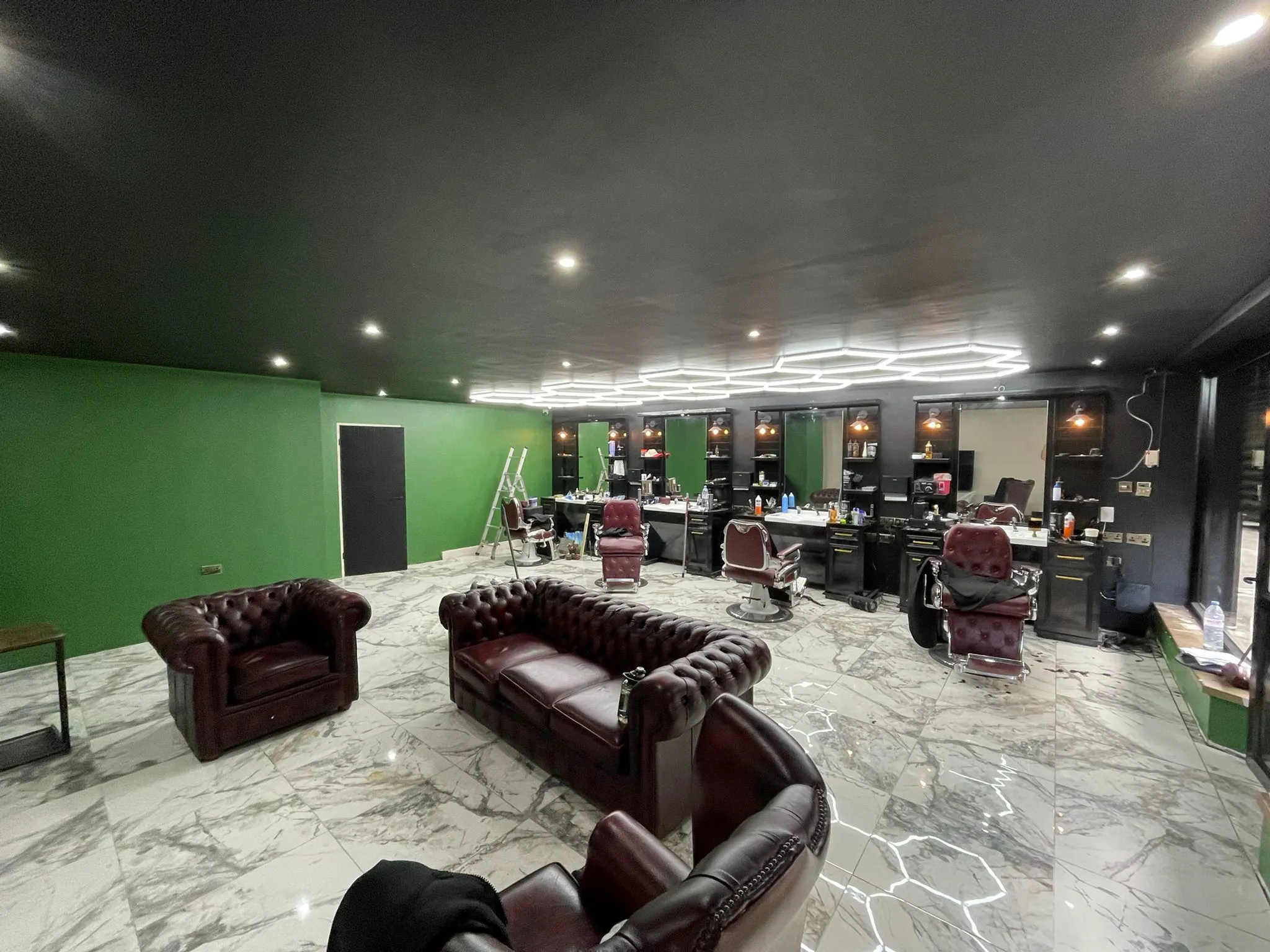
Salons and restaurants are often busiest when offices are empty. So the work is fitted around closing days and early mornings instead. Dark, dramatic schemes are popular in salons, and they need care. Deep colours often need an extra coat, and the finish has to cope with product splashes and constant wiping.
Paint that lets you reopen the next morning
The choice of paint decides whether the doors can open at eight. Modern water-based paints are low-odour and quick-drying. Walls are usually touch dry within a couple of hours, and can often be recoated the same evening.
However, always follow the manufacturer’s recoat time rather than rushing the second coat. Done properly, a room painted overnight can normally be used the next day.
For woodwork, water-based trim paints such as the Johnstone’s Trade Aqua range replace traditional oil-based gloss. They smell far less, dry faster and do not yellow like oil-based whites. It is the same approach we take on interior painting in homes, with tougher specifications where the traffic demands it.
Durable, scrubbable finishes
Corridors, stairwells and staff kitchens take knocks, scuffs and constant cleaning. For those, a durable, scrubbable finish is specified. Look for Class 1 wet scrub resistance under BS EN 13300 on the product data sheet. Dulux Trade Diamond and Crown Trade Clean Extreme are two ranges built for this kind of wear.
Sheen matters too. A matt finish hides uneven walls, while eggshell and satin wipe down more easily. Our guide to matt, eggshell, satin and gloss finishes explains the trade-offs.
Commercial finishes compared by area
| Area | Typical wear | Finish we would usually suggest | When the work is done |
|---|---|---|---|
| Open-plan office | Chair scuffs, light marking | Durable matt | Evenings, in zones |
| Corridors and stairwells | Knocks, trolleys, hand marks | Scrubbable matt or eggshell | Weekends |
| Staff kitchens and toilets | Moisture, splashes, frequent cleaning | Scrubbable or kitchen-and-bathroom finish | Evenings or weekends |
| Retail shop floor | Stock, fixtures, customer contact | Durable matt, satin on trims | After closing, section by section |
| Salon | Product splashes, heat, constant wiping | Scrubbable matt or eggshell | Closing days, early mornings |
| Café or restaurant | Grease, steam, chair backs | Scrubbable eggshell or satin | Between services or closing days |
| Shopfront exterior | Weather, grime, footfall | Exterior gloss or satin on joinery | Quiet hours, dry weather |
Brand colours, matched properly
Brand colours matter, and they are easy to get slightly wrong. A colour on a screen or a printed logo will not look the same on a wall. Therefore, colours are matched from a physical reference, such as a RAL, NCS or British Standard code, and sampled on site before sign-off. A Pantone reference can be matched closely, but not always exactly.
Once approved, the product, colour code and batch details are recorded. That makes future touch-ups simple, and it means a second branch can match the first.
New fit-outs need their own care. Fresh plaster in a new unit must be mist-coated before any brand colour goes on, just as it would at home. The same applies to new builds and fresh plaster across Salford, whether the unit is a flat or a shop.
RAMS, insurance and access
Commercial clients, landlords and managing agents usually ask for paperwork before work starts. That is reasonable, and a professional decorator should have it ready. Expect to see:
- A risk assessment and method statement (RAMS) written for your site.
- A public liability insurance certificate, with dates that cover the work.
- Product data sheets and safety data sheets for the paints being used.
- A programme showing which areas are worked on, and when.
Access equipment is chosen to suit the space. Podium steps cover most offices, while stairwells and high ceilings may need a mobile tower. The Health and Safety Executive publishes guidance on working at height, and a sensible contractor plans around it. If you are comparing contractors, our guide on how to choose a painter and decorator sets out nine checks worth making.
Protecting stock, equipment and IT
Protection in a commercial space goes beyond dust sheets. Desks and equipment are covered with polythene, and floors with heavy-duty protection. Computers and servers are never unplugged or moved without your IT contact’s say-so.
Sanding is done with dust-extracted sanders where possible, which matters near smoke detectors. Detectors are never covered or isolated without the building manager’s agreement, because the fire alarm has to keep working. Filling, sanding and stain sealing all follow the same surface preparation and finishing process we use on every job.
Where we draw the line
We will not use solvent-based products in a space people are working in. Oil-based gloss, some primers and certain stain blockers give off strong fumes as they dry. In a working office or salon, that means headaches, complaints and a smell that lingers into the next day. It is also a needless health risk for your staff and customers.
Instead, water-based alternatives are used wherever possible. Zinsser Bulls Eye 1-2-3, for instance, is a water-based primer that seals many common stains. Occasionally a solvent-based product is the only option, such as for a stubborn stain that keeps bleeding through. In that case, it is used only when the space is empty, with good ventilation and time for the air to clear before anyone returns.
Snagging and handover
Before any area is handed back, it is walked round with the site manager or owner. Marks, missed edges and light-catching patches are flagged with low-tack tape and put right. Nothing is signed off until you are happy with it.
After that, you receive a note of the products and colours used. Every zone is left clean, with furniture returned to where it started.
Get a free office painting quote in Manchester
Whether it is a single office, a shop floor or a salon, we will visit, walk the space and plan the work around your hours. The cost depends on the size and condition of the space, so the quote follows that visit. We also cover shops, offices and homes across Stockport.
Request a free, no-obligation quote or call 07835 733353. We are fully insured and happy to provide RAMS and certificates in advance.
Frequently asked questions
Can an office be painted outside working hours?
Yes. Most offices can be painted in the evenings and at weekends, so staff arrive to a finished space in the morning. Larger offices are split into zones and handed back one at a time. Keys, alarm codes, lift bookings and building manager requirements are agreed beforehand, so the work fits around the business rather than the other way round.
Can staff keep working while an office is being painted?
It is possible in a phased programme, where one zone is closed off while people work elsewhere. Low-odour, water-based paints make this far more comfortable, and solvent-based products should not be used around occupied areas. Even so, most businesses prefer the painting to happen out of hours, so desks are clear and nobody sits next to wet walls.
How long does the paint smell last after an office is painted?
With modern water-based paints, the smell is mild and usually fades quickly with good ventilation, often by the next morning. That is why a room painted in the evening can normally be used the next day. Solvent-based paints smell much stronger and for longer, so they should be avoided in working spaces or used only when the building is empty.
What does RAMS mean in painting and decorating?
RAMS stands for risk assessment and method statement. The risk assessment identifies the hazards on the job, such as working at height, fumes or trip hazards, and how each is controlled. The method statement explains step by step how the work will be done safely. Landlords, managing agents and commercial clients usually ask for RAMS before any work starts.
What is the best paint for office walls?
For most office walls, a durable, washable matt works well because it hides imperfections and copes with light marking. Corridors, stairwells, kitchens and toilets benefit from a scrubbable finish rated Class 1 for wet scrub resistance under BS EN 13300. Water-based products are the right choice in occupied buildings because they are low-odour and dry quickly.
How long does it take to paint an office?
It depends on the size of the space, the condition of the walls and when the work can happen. A small office or reception can often be done over a weekend, while larger floors are usually phased over several evenings or weekends. A site visit is the only reliable way to set a realistic programme for your building.
