


Painting skirting boards is the job everyone saves until last, and it usually shows. Skirting takes more knocks, scuffs and hoover strikes than any other surface in a room. It is also where poor preparation shows fastest, often as paint peeling off in long strips a few months later.
Here is how skirting is done properly as part of our interior painting service, including a method that keeps paint off the carpet.
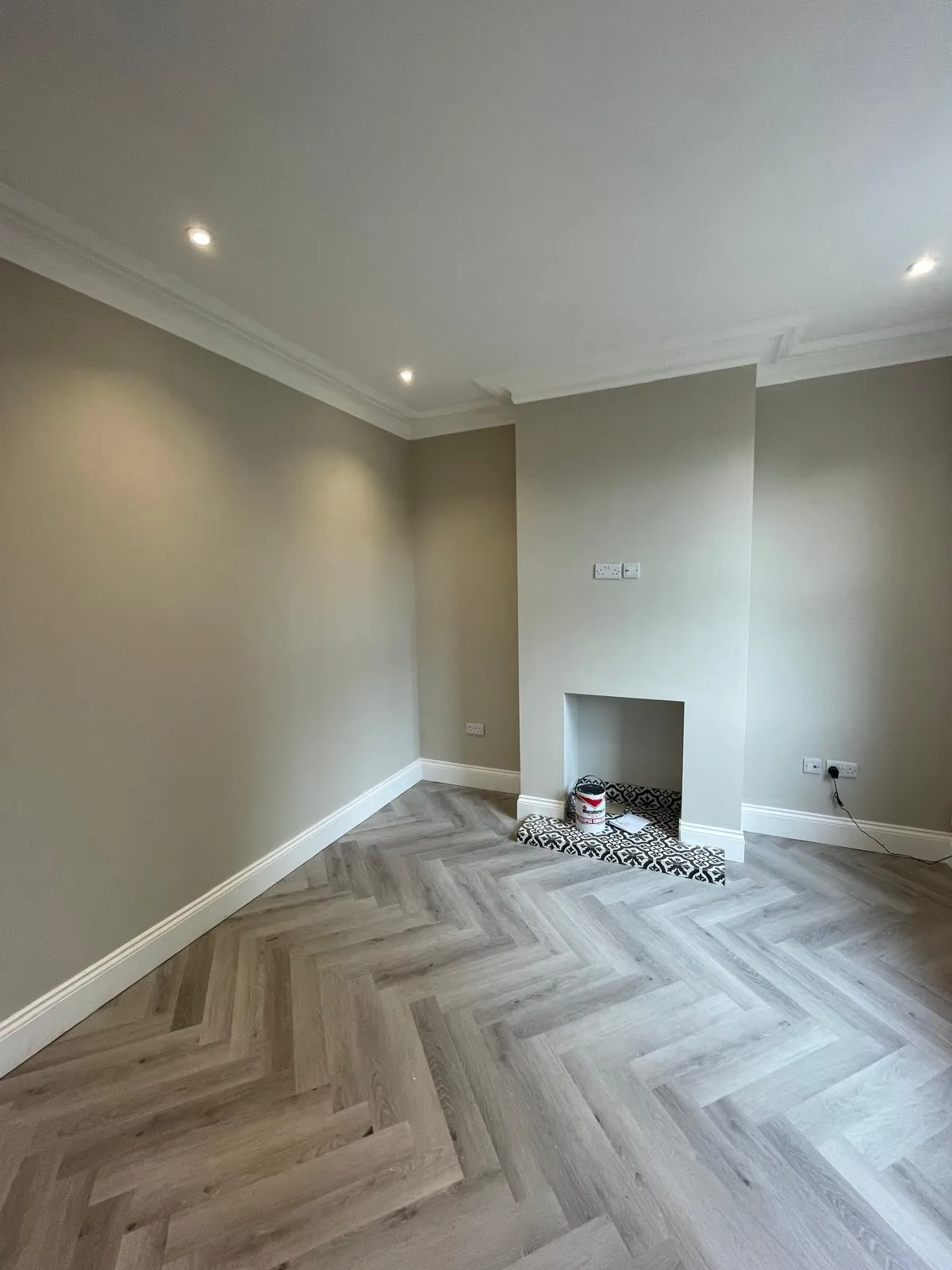
In short
- Old gloss is keyed and primed first, or new water-based paint peels off in strips.
- Skirting is degreased with sugar soap, filled, sanded and caulked along the top.
- Water-based satin stays white; oil-based gloss yellows, especially away from daylight.
- With the carpet down, a paint shield does the protecting; tape alone does not.
- Wipe the shield every few moves, or it prints paint onto the carpet.
- Matching skirting to the walls works well; change the sheen, not the colour.
Why skirting paint peels off in strips
Most skirting in older Manchester houses carries years of oil-based gloss. It is hard, shiny and slightly greasy from hands and hoovers. Water-based paint laid straight over it has nothing to grip.
For a while, it looks fine. Then, months later, a hoover catches an edge and the new paint peels away in a long, rubbery strip. That is not bad paint; it is a skipped step.
Is it oil or water-based?
To find out, rub a small hidden area with methylated spirits on a white cloth. If colour comes off on the cloth, the paint is water-based. If nothing happens, it is almost certainly oil-based gloss.
Another common find is skirting painted in wall emulsion. It goes on easily, but it is soft and porous, and it scuffs the first time a shoe touches it. It is sanded, primed and repainted in a proper trim paint.
Keying old gloss
After a wash with sugar soap, the shine is taken off completely with a 120 to 180 grit abrasive or a sanding sponge, working right into the mouldings. The dust is removed and the board wiped down. Over oil-based gloss, a bonding primer such as Zinsser Bulls Eye 1-2-3 then goes on before any water-based paint.
One caution for older homes. In houses built before the 1960s, the lower layers of paint may contain lead. It is tested before sanding, and dry sanding is avoided where lead is present or suspected.
Preparation: degreasing, filling and caulking the top gap
Skirting collects grease, dust and polish residue. Paint over that and it may not bond, or it dries with small craters where the grease pushes it away. Therefore the boards are washed with sugar soap, rinsed and left to dry before any sanding starts.
Dents and chips are filled next. A fine surface filler handles shallow knocks. Deeper damage, such as a chunk missing from an edge, is built up with a two-part filler and sanded back to the profile.
Knots in bare timber are sealed with knotting solution, so resin does not bleed through as a yellow-brown stain. New MDF skirting usually arrives primed, but it still gets a light sand and an undercoat.
Caulking the gap along the top
Walls are rarely straight, so a dark shadow line often opens between the board and the plaster. It is filled with a flexible decorator’s caulk from a sealant gun, then smoothed with a damp finger or a caulk tool. Caulk shrinks as it dries, so deep gaps are done in two passes.
Silicone is never used here, because paint will not stick to it. Follow the caulk manufacturer’s guidance on when it can be painted. This unglamorous stage is the heart of our surface preparation and finishing work, and it is where most of the time goes.
Water-based satin or oil-based gloss?
For decades, skirting in Britain meant brilliant white oil gloss. It flows out beautifully and dries rock hard. However, oil-based whites yellow over time, and they yellow fastest out of daylight: behind sofas, under radiators and along dim hallways.
Modern water-based trim paints do not yellow. Dulux Trade Diamond Satinwood and Crown Trade Fastflow Quick Dry Satin are two widely used examples, and good water-based glosses exist too. They dry quickly and smell far less, which matters in a home that is lived in while it is decorated.
| Finish | Sheen | Yellowing | Recoat time | Best for |
|---|---|---|---|---|
| Water-based satin | Mid sheen | Stays white | Typically a few hours; check the tin | Most homes, including hallways and family rooms |
| Water-based eggshell | Low sheen | Stays white | Typically a few hours; check the tin | Period rooms and colour drenching |
| Water-based gloss | High, a little less mirror-like than oil | Stays white | Typically a few hours; check the tin | A traditional look without the yellowing |
| Oil-based gloss | Very high, mirror-like | Yellows over time, faster out of daylight | Usually overnight; check the tin | A very hard finish, where yellowing is accepted |
Our guide to matt vs eggshell vs satin vs gloss explains sheen levels in more depth. Whichever you choose, water-based paint has one quirk. It sets fast, so it is laid off in long, light strokes and never brushed back over once it starts to grab.
Two coats are normal over a primed or undercoated board. Any nibs are rubbed down lightly with fine abrasive between coats. In a cold house in January, drying slows noticeably, so allow extra time before the second coat.
Painting skirting boards with the carpet down
Skirting is painted last, after the ceiling, walls, windows and doors, so nothing drips onto finished work. Our guide to what order to paint a room explains the full sequence.
In most homes, the carpet is staying put. That is fine, as long as the method respects it. It is the norm in the family homes we decorate across Sale, where carpets rarely come up just for decorating.
Before any tin is opened:
- the carpet edge is hoovered, so fluff and grit do not end up in the paint
- dust sheets are laid back from the skirting, leaving a clear strip to work in
- a damp cloth and a bucket of clean water are kept close for accidents
Using a paint shield
The shield is what actually does the protecting. A plastic paint shield, a wide filling knife or a strip of stiff card all work. It is pushed down between the carpet and the board, pressing the pile down and away from the bottom edge.
The top edge is cut in first, then the face, then the bottom edge with the shield in place. Work in shield-width sections, moving it along as you go. Keep the brush lightly loaded at the bottom, because a nearly dry brush gives a sharper line.
A good synthetic brush, around 1.5 to 2 inches, suits water-based trim paint. The board is painted in lengths of a metre or so, keeping a wet edge, and laid off along the grain.
Wipe the shield every few moves
This is where most carpets get marked. Paint builds up on the edge of the shield. The next time it is pushed into the pile, that paint goes with it. So the shield is wiped clean on a rag every few moves, without exception.
If the carpet is being replaced anyway, paint the skirting before the fitters arrive. On wood, laminate or tiles, low-tack tape along the floor works well, because it has a flat surface to grip.
Should skirting match the walls?
Brilliant white skirting against coloured walls is the default, but it is not the only option. Colour drenching, where walls and woodwork are painted the same colour, makes a room feel calmer and often larger. It also hides scuffs far better than white. In busy hallways, a mid-tone or darker skirting copes with shoes, bags and buggies in a way white never will.
The trick is to change the sheen, not the colour. Matt walls with eggshell or satin skirting in the same shade give definition without contrast. Farrow & Ball and Little Greene both make wall and woodwork finishes in matching colours, which makes this straightforward.
Deep, ornate skirting deserves more thought. The tall boards and period mouldings in Altrincham, Bowdon and Hale can look superb in a heritage shade a little darker than the walls. At the other end of the scale, spraying gives a flawless, brush-free finish in empty rooms, much like our spray-finished trim in Worsley.
When DIY is fine and when it isn’t
Painting skirting boards is one of the more manageable DIY jobs. A few rooms of water-based over water-based is well within reach, especially with hard floors or a carpet due for replacement.
It is worth bringing in a decorator when:
- a whole house of yellowed oil gloss needs keying, priming and converting to water-based
- deep period mouldings are clogged with old paint and need careful work
- the carpet is new, pale or expensive
- commercial and rental properties need hard-wearing trim with minimal downtime
If you would rather hand the whole room over, our professional house painting in Manchester treats the woodwork with the same care as the walls.
Where we draw the line
We do not mask carpet with tape alone. It is a common shortcut, and it rarely ends well.
Tape cannot grip a carpet pile properly. The fibres lift under its edge and paint wicks into them. When the tape comes off, it can also pull fibres loose or leave adhesive behind.
Tape still has a place. Tucked down between the board and the carpet, it adds a second line of defence. However, the shield does the real work, and it is wiped every few moves.
Get a free quote in Manchester
Whether it is painting skirting boards in one room or all the woodwork in a house, we are happy to take a look. We work as house painters across Manchester and Greater Manchester, and we are fully insured. Cost depends on the number of rooms and the condition of the woodwork, so we always see it first.
Call us on 07835 733353 or request a free, no-obligation quote.
Frequently asked questions
Do you need to sand skirting boards before painting?
Yes, in most cases. Old gloss must be sanded until the shine has gone, or new paint has nothing to grip and can peel off in strips. Even boards already in a water-based finish benefit from a light sand to remove nibs and give a key. Wash them with sugar soap first, so you are not sanding grease into the surface.
Can you use water-based paint over oil-based gloss?
Yes, but not straight on. The gloss is washed with sugar soap, sanded until it is dull, and then coated with a bonding primer such as Zinsser Bulls Eye 1-2-3. Without that preparation, water-based paint sits on the surface and can peel away months later when it is knocked or caught by a hoover.
What is the best paint for skirting boards?
For most homes, a durable water-based satin or eggshell is the best all-round choice. It stays white, dries quickly, smells far less than oil-based paint and stands up well to knocks. Oil-based gloss gives a harder, shinier finish but yellows over time, particularly in rooms or corners that get little daylight.
Why has my white gloss skirting turned yellow?
Oil-based white paints yellow naturally as they age, and the effect is strongest where there is little daylight, such as behind furniture or along dim hallways. Heat from nearby radiators can make it worse. The fix is to key the old gloss, prime it and repaint in a non-yellowing water-based finish.
How do you paint skirting boards without getting paint on the carpet?
Hoover the carpet edge first, then use a paint shield, a wide filling knife or stiff card to press the pile down and away from the board. Paint in short sections, moving the shield as you go, and wipe its edge clean every few moves. Keep a damp cloth close by, and do not rely on masking tape alone.
Should skirting boards be the same colour as the walls?
They can be, and it often looks excellent. Painting skirting the same colour as the walls, known as colour drenching, makes a room feel calmer and hides scuffs better than white. Use a tougher eggshell or satin on the skirting and matt on the walls, so the woodwork is defined by sheen rather than colour.
