

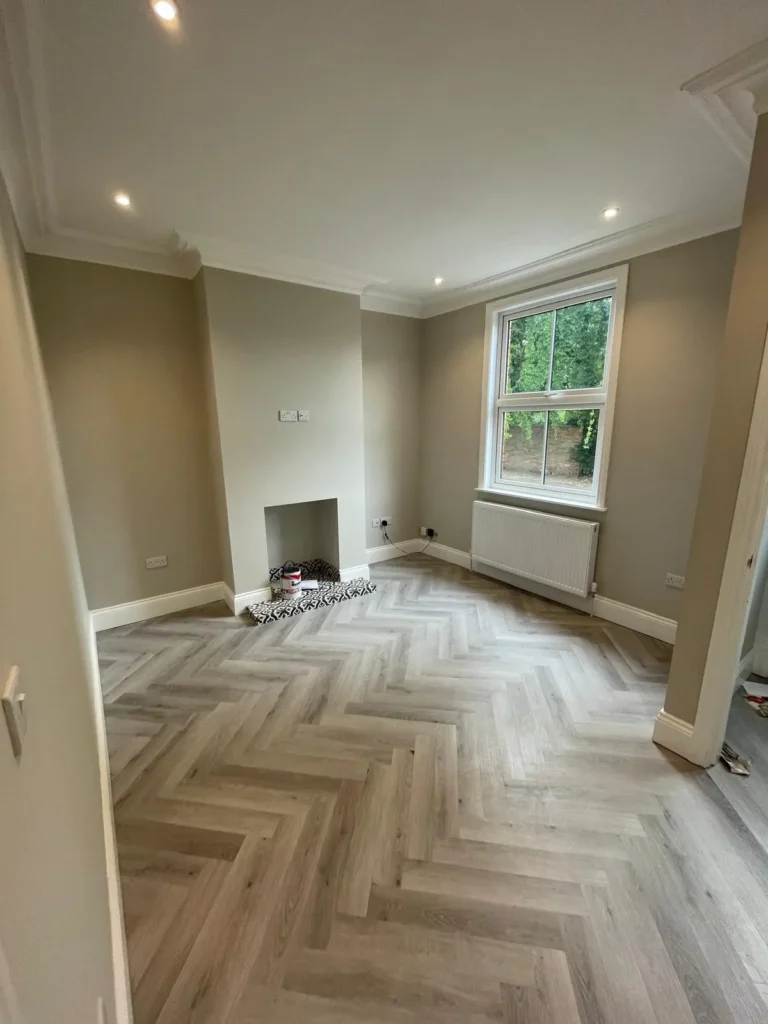
Learning how to wallpaper a flat, empty wall takes an afternoon. The trouble is that very few walls are flat and empty. There is a window, a double socket, a radiator and a pipe running up beside it. That is where a job is won or lost.
This guide takes each obstacle in turn, the way our wallpaper hanging service tackles them in Manchester homes.
In short
- Hang the first length to a plumb line, never to a corner or a window frame.
- Isolate the circuit at the consumer unit before papering round sockets and switches.
- Loosen the faceplate, star-cut over it, trim the flaps and tuck them behind.
- Take radiators off where possible; otherwise feed paper behind with a radiator roller.
- Around pipes, slit the paper from the nearest edge and relieve it so it lies flat.
- Check every batch number, allow for the pattern repeat and keep a spare roll.
Before you hang: lining, sizing and batch numbers
Wallpaper does not hide a poor wall. It follows every crack, filler patch and ripple, and a thin or dark paper makes them more obvious, not less. So the wall is judged before the paper is chosen.
A wall that is sound but uneven is lined first. Lining paper is hung horizontally, which is known as cross-lining, so its joints never line up with the vertical joints of the finish paper. It is butt-jointed, never overlapped, and left overnight to dry. A heavier grade, such as 1200 or 1400, bridges more of the wall’s faults.
Bare plaster and filler patches are sized with diluted paste or given a wallpaper primer. That evens out the suction, so the paper dries at the same rate everywhere and can be slid into position. Filling, sanding and lining like this is all part of our surface preparation and finishing work.
Finally, check the batch number on every roll before cutting anything. Different batches can vary slightly in shade, and the difference often only shows once two lengths sit side by side.
Paste the wall or paste the paper?
The label tells you which method the paper needs, and it matters most around obstacles. A paper that stays stable when wet is far easier to cut round a socket or fold into a reveal.
| Paper type | Pasting method | Soaking time | Around obstacles |
|---|---|---|---|
| Non-woven | Paste the wall | None; hung dry from the roll | Stable and easy to reposition; trims cleanly |
| Traditional paper | Paste the paper | Booked for the time on the label | Softens when wet, so it tears easily at cuts |
| Vinyl | Paste the paper, or pre-pasted | Booked or dipped, as the label says | Needs overlap adhesive wherever vinyl laps onto vinyl |
| Lining paper | Paste the paper | A short booking time | Hung horizontally and butt-jointed before the finish paper |
Booking means folding the pasted length on itself, paste to paste, and leaving it to soak. The paper expands as it absorbs water. Therefore every length is booked for the same time, or the widths vary and bubbles or gaps appear as it dries.
Non-woven paper does not expand, so the paste is rolled onto the wall instead, slightly wider than the length. It also strips off dry in whole lengths, which makes wallpaper removal far easier when you next redecorate.
Where to start: plumb lines and the first length
Corners, door frames and window frames are rarely true. That is especially so in the period homes of Altrincham, Bowdon and Hale, where a wall can lean noticeably over its height. Hang the first length to one of them and every length after it drifts.
Instead, a vertical line is marked with a plumb bob or a laser level. It is drawn in pencil, because ballpoint and felt-tip bleed through paper. Each length is then cut with about 50 mm spare at the top and bottom for trimming.
Where you start depends on the paper:
- Bold patterns are centred on the chimney breast or focal wall, then hung outwards in both directions.
- Plainer papers start beside the main window and work away from it, so the final join lands somewhere discreet.
At internal corners, the paper turns only a few millimetres onto the next wall. The offcut then starts afresh from a new plumb line.
How to wallpaper around sockets and switches
Electricity and wet paste do not mix, so this is always done in the same order.
- The circuit is isolated at the consumer unit, and the socket or switch is checked dead.
- The faceplate screws are loosened a few turns so the plate comes forward slightly. It is not pulled away from the box.
- The length is hung over the fitting and smoothed down to it.
- The paper is pressed lightly to find the plate, and a star cut is made from the centre out towards each corner.
- The flaps are trimmed back to a few millimetres, tucked behind the plate, and the screws are nipped up without overtightening.
- Paste is wiped off the plate, and the power stays off until no wet paste remains near the box.
Metal faceplates need more care. They carry an earth connection, so they are never pulled far enough to strain the wiring. With foil or metallic papers, the paper is trimmed neatly to the plate edge rather than tucked behind, because foil conducts electricity.
If a backbox is loose, a plate is cracked or there are any scorch marks, stop. That is a job for an electrician, not a decorator, and we will tell you so.
Wallpapering around windows, reveals and returns
Most terraces and 1930s semis in Manchester have windows set into a reveal. The paper has to turn into the recess neatly, while the pattern carries on above and below the window.
- The length that overlaps the window is hung as normal, with the spare left loose over the opening.
- Horizontal cuts are made in line with the top of the reveal and the top of the sill.
- The flap between the cuts is folded into the reveal, smoothed onto the return and trimmed at the frame.
- A patch is cut for the underside of the reveal head, slightly oversized so it turns onto the wall above.
- Short lengths are hung above and below the window, keeping the pattern running, and wrapped into the reveal head.
Before the far side of the window, a new plumb line is marked. Short lengths drift easily, and the full length that follows must be vertical.
Importantly, never let a joint fall on the arris, the sharp outer edge of the reveal. It takes knocks and lifts quickly. Plan the lengths so the paper wraps round the edge instead.
Flush frames and floor-to-ceiling glazing are simpler: the paper is creased against the frame and trimmed with a sharp blade, snapped off often.
Wallpaper behind radiators: off the wall or tucked behind
The neatest finish comes from taking the radiator off the wall. The heating is turned off and allowed to cool, and both valves are closed. The turns on the lockshield valve are counted, so the system stays balanced afterwards.
The unions are undone, the radiator is drained into a tray, and it is lifted off its brackets. Once it goes back, the system is bled, and a sealed system may need its pressure topping up. If you are not confident with your heating, leave that part to a heating engineer.
If the radiator stays, the paper can still go behind it. The radiator must be cold, or the paste dries too fast and the paper shrinks back. The length is slit up from the bottom to the line of each bracket, fed down behind and pressed flat with a radiator roller. It only needs to go far enough that no edge shows from the room.
Pipes: slit and relieve
Pipes look harder than they are. For a pipe coming out of the wall, the length is hung down to it. It is then slit from the nearest edge of the paper to the pipe. A few short relief cuts around the pipe then let the paper lie flat.
The slit closes up as the paper is brushed down, and a pattern hides it well. Pipe collars, the small covers that slide over radiator tails, conceal the cut altogether.
Pattern matching and waste
The pattern repeat is printed on the label, along with the match type. It decides how much paper you lose to offcuts.
- Free match papers, such as plain textures and stripes, can be hung from any point on the roll.
- Straight match papers repeat at the same height across every length.
- Half-drop papers shift by half a repeat on alternate lengths, so they waste the most.
With a half-drop, lengths are often cut from two rolls alternately to reduce waste. Hang the first two lengths and check the match in daylight before cutting the rest. Mural-style papers, like the one pictured, often come as panels printed in sequence. Each panel is laid out and checked in order before any paste goes on.
Pattern scale changes how a room feels, and so does the paint around it. Our colour and finish guidance for Kearsley homes covers that balance. So does our guide to choosing paint colours for the walls that are not papered.
When DIY is fine and when it isn’t
Knowing how to wallpaper a feature wall in a spare bedroom is a realistic DIY skill. A non-woven paper on a sound, flat wall, with one socket and no window, is a good place to learn.
A professional is worth it for:
- stairwells with long drops and awkward access, as covered in our hall, stairs and landing guide
- expensive designer papers and murals, where one wrong cut wastes a whole roll or panel
- old, uneven walls that need lining before anything decorative goes up
- busy family homes in Sale and elsewhere, where rooms need to be back in use quickly
Often only one wall is papered and the others are painted. We handle the papering and the interior painting in the same visit.
Where we draw the line
We will not hang paper on a wall that needs lining first. And we will say so before you buy the paper, rather than after it is up.
The reason is simple. A paper hung straight onto a cracked, patched or uneven wall shows every fault, and uneven suction can make joints open as it dries. Many wallpaper makers recommend lining in their own hanging instructions for exactly that reason.
Telling you at the quote stage costs nobody anything. Telling you after the paper has been bought, or worse, after it has been hung, helps no one.
Get a free quote in Manchester
If you would rather not learn how to wallpaper on a paper you spent months choosing, we will happily hang it. We work as house painters and decorators across Manchester and Greater Manchester, and we are fully insured. Cost depends on the room, the wall and the paper, so we always see it first.
Call us on 07835 733353 or ask for a free, no-obligation quote.
Frequently asked questions
Where do you start when wallpapering a room?
Start from a plumb line, not a corner, because corners and frames are rarely vertical. For a bold pattern, centre the first length on the chimney breast or focal wall and work outwards. For plainer papers, start beside the main window and work away from it, so the final join lands somewhere discreet, such as behind a door.
Do you need to turn the electricity off to wallpaper around a socket?
Yes. Isolate the circuit at the consumer unit and check the socket or switch is dead before loosening the faceplate. Keep the power off until the paper is trimmed, the plate is refitted and there is no wet paste near the box. If the backbox is loose or anything looks damaged, call an electrician before going any further.
Can you wallpaper behind a radiator without taking it off?
Yes. With the heating off and the radiator cold, slit the length up from the bottom to the line of each bracket, feed it down behind the radiator and press it flat with a long-handled radiator roller. It only needs to go far enough that no edge is visible from the room. Taking the radiator off the wall still gives the neatest result.
Should I use lining paper before wallpapering?
Use it whenever the wall is sound but uneven, patched or cracked, and whenever the paper is thin, dark or expensive. Lining paper evens out the surface and the suction, so the finish paper dries evenly and the joints stay closed. It is hung horizontally so its joints never line up with the finish paper, then left overnight to dry.
What is the difference between paste the wall and paste the paper?
Paste-the-wall papers, usually non-woven, are hung dry: the paste is rolled onto the wall and the paper applied straight from the roll. Paste-the-paper types, such as traditional and many vinyl papers, are pasted and then folded to soak for the time on the label. That soaking lets them expand before hanging, so they do not bubble or open at the joints.
How many extra rolls of wallpaper do I need for pattern matching?
It depends on the size of the pattern repeat and the match type, both printed on the label. A large repeat or a half-drop match wastes more paper than a free match. Work out how many lengths the room needs, allow for the repeat on each one, and buy at least one spare roll from the same batch for mistakes and future repairs.
