

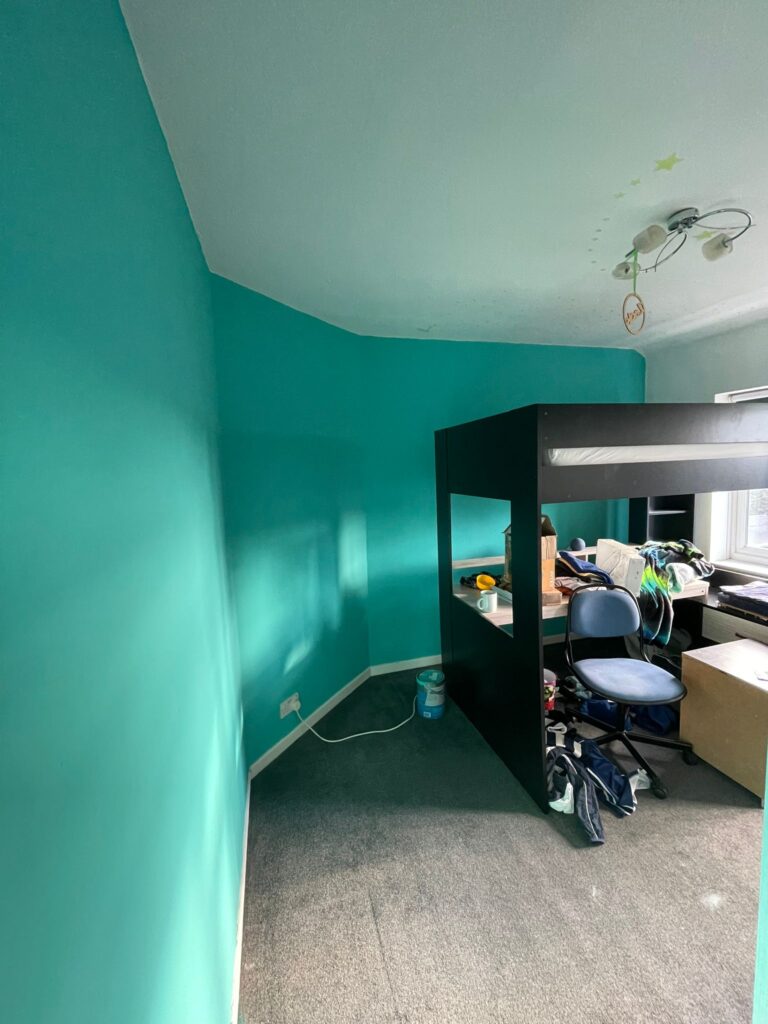
How many coats to cover dark walls? Usually one tinted basecoat and two finish coats, although a deep red or navy can ask for more. The real answer depends on the old colour, the new one and what is in the tin.
Here is how our interior painting team handles big colour changes in Manchester homes, whether that means light over dark or dark over light.
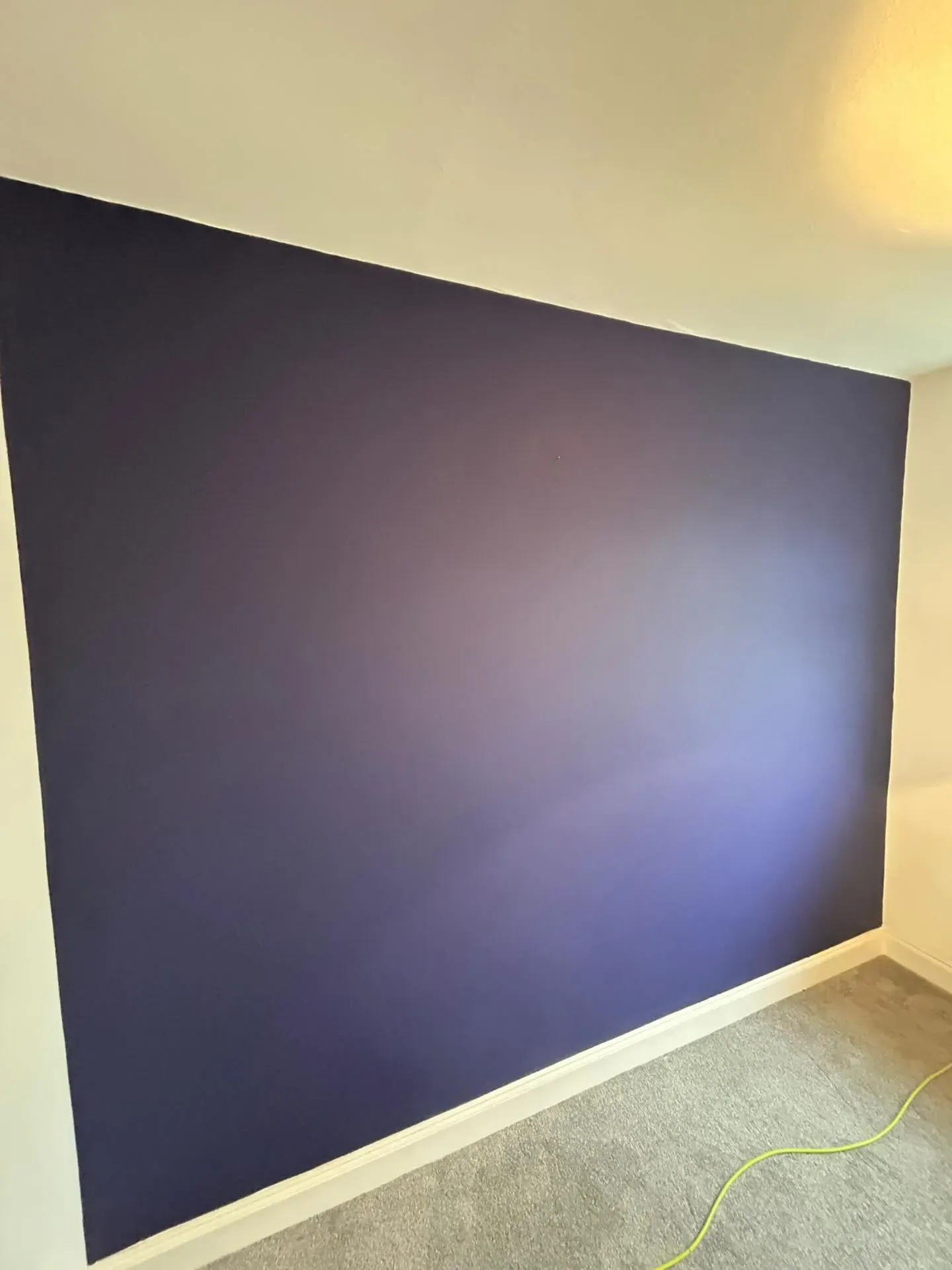
In short
- Light over dark usually means one grey-tinted basecoat, then two coats of the new colour.
- Skip the basecoat and it can take three or four coats, with the old colour still ghosting through.
- Deep reds are notoriously hard to cover, and bright reds and yellows are hard to apply.
- Dark over light often needs three coats, because deep-base paints contain little white pigment.
- Trade paint generally hides better than budget paint, but no paint changes a strong colour in one coat.
- Judge coverage in daylight once the paint is fully dry, not under evening lamps.
Why dark colours are so hard to cover
Paint hides what is underneath by scattering and absorbing light. In pale colours, most of that work is done by titanium dioxide, the white pigment in the base. A thin film of pale paint over navy simply lets some of the navy through.
Decorators call this grinning, or grin-through: a shadow of the old colour showing under the new. The bigger the jump in lightness, the more total paint film is needed to hide it. As a result, a colour change is limited less by effort than by physics.
Hue matters as well as depth. A strong red, purple or blue shows through as a tint, and the eye picks up a tint in a pale colour very easily.
How many coats to cover dark walls with a light colour
The reliable method starts with a basecoat. On a typical light-over-dark job, the sequence runs like this:
- The wall is washed, keyed and filled, and repairs are spot-primed.
- A primer-undercoat or contract matt, tinted to a mid-grey, is cut in and rolled.
- It is left for its full recoat time, then the first coat of the new colour goes on.
- A second finish coat follows, and coverage is checked in daylight once it is dry.
Grey works better than white for a reason. A little black pigment makes paint far more opaque, so a grey basecoat blots out a dark colour in fewer coats than white can. It also neutralises the hue, so the topcoat is covering a flat grey rather than a strong blue or red.
Most trade counters can tint a basecoat to order. Farrow & Ball, for instance, sells its primer and undercoats in several tones to suit the finish colour. The grey is chosen to match the job: lighter under pale shades, deeper under mid-tones.
Prepare the old dark paint first
A basecoat is only as good as the surface under it. The walls are washed down and any sheen is keyed with a light sand. Dark feature walls are sometimes in silk emulsion, which new paint grips poorly until it has been dulled.
Filler patches are spot-primed so they do not flash through the new colour. Our guide to preparing walls for painting covers the full routine. It matters more with a colour change than anywhere else, which is why it sits at the heart of our preparation and finishing work.
Reds and yellows: the stubborn ones
Reds cause trouble in both directions. A deep red or burgundy under a pale colour tends to show as a pink cast, even after several coats. A grey basecoat neutralises it before the new colour goes on.
Bright reds and yellows are just as awkward to apply. The pigments that give them their clean, strong colour hide poorly, so they go on streaky and translucent. Magnolia to a sunny yellow is the classic trap: the old colour is pale, yet the new one still needs extra coats. Therefore use the undercoat colour the manufacturer recommends, and expect three or more coats if you skip it.
Dark over light: why deep colours need more coats
Going the other way surprises people. Surely dark paint covers white easily? Often it does not, and the reason is in the tin.
Tinted paint starts as a base. Pale colours are mixed from a light base rich in titanium dioxide. Deep colours such as navy, forest green or charcoal use a deep base with far less white pigment, leaving room for the colourant. That base has lower hiding power, so dark over light often needs three coats.
A basecoat tinted to a mid-tone version of the finish colour usually brings that back to two. Deep colours are also unforgiving to apply. They show roller marks, lap lines and patchy cutting in, so each wall is finished in one go.
On a large room, the tins are boxed, meaning they are mixed together in one big container. This evens out tiny shade differences between tins, which show far more in a navy than in a magnolia.
Colour changes at a glance
| Colour change | Basecoat | Typical finish coats | Watch for |
|---|---|---|---|
| Navy, charcoal or deep green to a pale colour | Grey-tinted primer-undercoat | Usually 2 | Grin-through in daylight |
| Deep red or burgundy to a pale neutral | Grey basecoat, not white | Usually 2, sometimes 3 | A pink cast showing through |
| White or pale to a deep colour | Mid-tone of the finish colour | 2 with a basecoat, often 3 without | Roller marks, lap lines and flashing |
| Any colour to a bright red or yellow | The manufacturer’s recommended undercoat tone | Often 3 or more | Streaky, translucent coats |
| Similar tone to similar tone | Usually none needed | 2 | Patchy filler repairs |
| Bare new plaster to any colour | Mist coat | 2 | Suction and uneven sheen |
These are typical figures, not promises. The condition and sheen of the old paint, and the product going on, can all shift the numbers.
Budget paint versus trade paint
Not all paint hides equally. Budget emulsions tend to carry less pigment and more extender, the chalk and clay fillers that bulk paint out. They look fine in the tin but go on thin.
Trade ranges such as Dulux Trade, Crown Trade, Johnstone’s Trade and Tikkurila are generally more consistent in opacity. Even so, a better paint may save a coat; it will not replace the basecoat. One-coat paints are thick and heavy-bodied, and they rarely manage a strong colour change in a single pass.
The spreading rate matters too. The coverage figure on the tin assumes a full, even coat. Stretch the paint thinner and you will need another coat anyway.
Patchiness, flashing and sheen
Flashing is a patch of different sheen that shows when you look at the wall from an angle. It usually appears over unprimed filler, where paint was overworked, or where a cut-in edge dried before the roller reached it. Dark colours show it most.
Touching up a dark wall rarely works for the same reason: the patch shows as a different sheen. Instead, the whole wall is recoated from corner to corner.
Sheen makes all of this worse. Matt hides flaws best, while eggshell and satin show every lap and repair. Deep matt colours can also burnish, turning shiny where they are rubbed, so a scrubbable durable matt suits busy rooms. Our comparison of matt, eggshell, satin and gloss finishes explains the trade-offs.
Checking coverage in daylight
Wet paint flatters. A coat that looks solid when wet can dry patchy, so coverage is only judged once the recoat time has passed.
Warm evening lamps hide grin-through, so check in daylight. A flat, overcast Manchester morning is actually an honest light for colour. Low sun raking across the wall is best for spotting roller marks and texture. In the dim back room of a Victorian terrace, check at midday with the lights off.
Check the cut-in lines first. A brush lays a thinner film than a roller. As a result, grin-through usually shows first along the ceiling line, in the corners and around sockets.
Stand near the window and look along the wall, not straight at it. If you are unsure whether it needs another coat, it usually does.
Landlords, natural paints and colour advice
End-of-tenancy work raises this question all the time. A tenant’s navy feature wall has to go back to a neutral before the next let. The extra coats need planning into the turnaround. We handle this for landlords doing HMO and end-of-tenancy work in Withington, and through our residential and commercial painting service.
Natural and low-VOC paints need their own thinking. Some clay and mineral paints behave quite differently from a standard vinyl emulsion. Over a strong colour, follow the maker’s full system, including its recommended primer. We often work with these products for homeowners choosing low-VOC and natural paints in Prestwich.
Still deciding what goes over the dark wall? Our guide to choosing paint colours covers light and undertones. We also give colour and finish guidance in Kearsley and beyond.
Where we draw the line
We will not promise two coats over a deep red or navy before we have seen it. Coverage depends on the old paint’s colour, sheen and condition, on past repairs and on the colour going on. A number given over the phone is a guess.
Nor will we skip the basecoat to hit a number. Two coats straight over navy can look fine at 9pm under a lamp and shadowy at 11am. A third and fourth coat then go on anyway, and the finish ends up thicker and less even than it needed to be.
Going light over dark is well within DIY reach with a basecoat and some patience. Bring in a professional in these situations.
- Stairwells and tall hallways.
- Large open-plan rooms, where lap marks are hard to avoid.
- Flaking paint or badly repaired walls.
- A room that must be back in use by a fixed date.
Get a free quote in Manchester
If your dark walls need to go light, or the other way round, we are fully insured, 5-star rated painters and decorators across Manchester. We will look at the walls, tell you honestly how many coats they need and quote for exactly that.
Request your free, no-obligation quote or call 07835 733353.
Frequently asked questions
Can you paint a light colour over a dark colour?
Yes. The reliable way is a grey-tinted basecoat or primer-undercoat over the dark colour, followed by two coats of the new light colour. Going straight on with the light colour can work, but it often takes three or four coats and may still leave a shadow of the old colour showing through in daylight.
Do I need a primer to paint over dark paint?
It is strongly advisable. A primer or basecoat tinted to a mid-grey hides a dark colour far more efficiently than a pale topcoat can, so fewer coats are needed overall. If the old dark paint has a sheen, such as silk emulsion, give it a light sand first so the new coats grip properly.
Why does red paint show through white?
Red is one of the hardest colours to cover because it keeps showing through pale paint as a pink cast. A white topcoat has limited power to hide a strong hue on its own. A grey basecoat neutralises the red before the white goes on, which usually gives a clean result in two finish coats.
How many coats of a dark colour do you need over white?
Plan for three. Deep colours are mixed from bases that contain little white pigment, so they are less opaque than pale colours. A basecoat tinted to a mid-tone of the final colour can bring it down to two finish coats. Apply full, even coats at the spreading rate on the tin rather than stretching the paint thin.
Is one coat paint good enough to cover a dark wall?
Not usually for a strong colour change. One-coat paints are thick and cover well over a similar colour, but they rely on being applied heavily and evenly. Over navy, red or charcoal, a basecoat followed by two finish coats gives a more even and reliable result than one heavy coat.
Why does my wall look patchy after two coats?
Patchiness usually comes from uneven film thickness, filler that was not spot-primed, or edges that dried before the roller reached them. Darker colours and higher sheens show it most. Check the wall in daylight once the paint is fully dry, then apply a further full coat, working one wall at a time and keeping a wet edge.
